Showing posts with label pearls. Show all posts

Wednesday, July 25, 2012

Big Old Oyster Found With Suspected Enormous Pearl Inside

An oyster believed to possibly be 150 million years old was recently found near the Solent strait, which separates mainland England from the Isle of Wight.  Discovered in the nets of a fishing boat, after the mud and dirt was washed off they realized it was not a rock but a large, solid, fossilized oyster shell which had turned to stone.  Given to the nearby Blue Reef Aquarium, they estimated the age based on the 200 annual growth rings found on the shell. The Aquarium recently performed an MRI on the oyster and found a golf ball sized object inside which experts believe could be one of the largest gem quality pearls in the world.  However, it is not expected to be larger than the clam produced, fourteen pound, uglier than hell Pearl of Allah (estimated worth of $60 million).

However pearl lovers...this oyster will not be opened anytime soon.  Experts are taking the high road on this one and preserving the integrity of the ancient find so anyone interested in the pearl as jewelry...you will have to wear this entire nasty thing around your neck along with the MRI results nailed so your forehead to everyone can see.

Abnormal MRI showing huge growth inside the oyster.  So glad this is not of my brain.

Contrary to popular belief, one should eat this oyster in months without "R"'s.

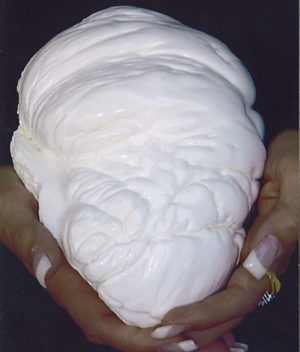
The Boris Karloff pearl...I mean the Pearl of Allah.


Friday, June 8, 2012

Kate - The Girl with a Fake Pearl Earring

Would someone please tell the new royals
 they do not have to wear paper bags on their heads all the time?
What did you think about the Duchess of Cambridge's faux pearl earrings?  I don't know about you but her frugal nature is beginning to get a tinkly bit old.  She must have access to some of the most amazing jewels in the world and, dammit, I want her to wear them.  I know she's trying hard to fit in with the Royal family's desire to be seen as non-squandering leeches by wearing the same schmatta more than once and by recycling those L. K. Bennett shoes until the heels are scuffed, but come on, they are one of the world's wealthier couples. Don't you miss Princess Diana's pearls, sapphire and diamonds? 

Remember the jeweled headband she wore that night?  Where did that come from?

Friday, January 27, 2012

PBS And Their Dasterdly "Downton Abbey" Deed

If you are like many people in America right now, you have been sucked into the Downton Abbey" vortex on Sunday nights.  My Sunday night television obsession has gone from the depths of the Real Housewives of Wherever to the current highbrow Downton Abbey, and directly following, "Sherlock".  Now I feel very intelligent when I watch TV on Sunday night instead of the goober I used to feel like when I watched the housewives.

But PBS has recently come under fire for selling a collection of jewelry based on Downton Abbey on their website.  They are under fire not because as some have said, the collection is tacky, but because they did it without informing the shows creator.  See for yourself...

A replica of a cameo from the show.  Cameos were very popular in the early 20th century.  Typically carved in shell, cameos were also carved in gemstones like agate, onyx and sardonyx.

Pearls were often used in jewelry during the Victorian and Edwardian age.  They were small and natural, (unlike these Downton Abbey replicas which are faux).
Downton Abbey's Crawley women. 
This is what women looked like before Gloria Steinem, masters degrees, the gym, wine and Starbucks.
The girls and their pearls.  Here are the ladies and some of their PBS knock-offs.
Some felt the tea set (shown in the bottom right corner) was particularly heinous.
So really, what is all the fuss about?  Did Willow or Patrick at PBS get a little too aggressive when brainstorming beg-a-thon ideas?  PBS stuck their neck out in an effort to raise funds and with all the cutbacks in contributions, if they don't stay on their toes, they will go dark...and that would be bad. 

It's a shame PBS had to pull the jewelry off their website.  Had they collaborated with the shows creator from the beginning, together they could have spawned a new trend in clothing and jewelry.  Yes people, women now want the clothes too - especially the blouses. 

Come on...who would you rather see in pearls?

Wednesday, June 8, 2011

Cartier Pearls

LA PEREGRINA PEARL:  In Spanish, la peregrina means "the Pilgrim."  A naturally formed pearl, it is considered one of the most historically important pearls in the world.  Legend has it that in the 16th century, a slave in the Gulf of Panama discovered the pearl and exchanged it for his freedom. (I sure hope he made it out).  King Ferdinand V (1479-1516) made the pearl part of the Spanish Crown Jewels.  It was then passed to his successor, King Charles V (1516-1556).  King Phillip II of Spain gave the pearl to Queen Mary I (Mary Queen of Scots) in anticipation of their marriage in 1554 (there are many portraits of her wearing the pearl which is very cool when you think about it in current times).  It was also owned by Spanish royalty, the Bonapartes of France, and the British Marquis of Abercorn.

The pearl, almost 56 carats in weight, was hanging from a very beautiful tiny pearl and platinum chain necklace when Richard Burton purchased it in 1969 for Elizabeth Taylor. Three years later, Liz and Dick took La Peregrina, along with a copy of a painting of Mary Queen of Scots, to Cartier in New York with a request to have the pearl reset in a necklace similar in design to the one worn in the painting. The new necklace design is based on the necklace worn in the painting from the 16th century.   


Liz's Convincing Conversation to Dick...

Dick....guess what?  I've decided this thing is way way too small and it does not counterbalance my bubbies.  I can hardly stand to wear it.  I must redo the whole thing and make it as ostentatious as possible.  I think I'll copy Queen Mary's necklace from that painting we like.  You know Dick, remember we're British so we're almost like royalty and stuff.  Hell, I deserve it.
The painting of Queen Mary with PMS, by Flemish artist, Hans Eworth, which is believed to have inspired Elizabeth Taylor and Richard Burton.  It shows the monarch wearing the giant pearl known as La Peregrina.  What could Mary possibly be so pissed off at?  Is a pearl the size of a bird's egg too heavy around the neck?  Elizabeth Taylor will look slightly less pissed off when Richard Burton buys the pearl for her 400 years later.


Cartier's hand drawings of Taylor’s new necklace which will hold La Peregrina.  Based on the PMS'ing Queen Mary painting shown above.  

Le Peregrina on Cartier Necklace:  In 1969 Richard Burton gave the magnificent pearl to Elizabeth Taylor for Valentine's Day (hell, I only ever get a card).  Purchase Price:  $37,000.  Shortly after receiving it, Ms. Taylor temporarily lost it later finding it in her dog’s mouth (like my mother used to say, "Gem, you just have too much crap laying around").  Realizing an egg sized pearl on a chain was just not enough, Taylor asked Cartier to design a necklace to hold it.  The new necklace features a double strand of different sized pearls, with ruby and diamond stations interspersed throughout with La Peregrina attached as an elaborate pendant. The centerpiece of the pendant is a floral design consisting of a pear-shaped ruby surrounded by diamonds in a floral pattern. 


The final Cartier necklace which, of course, Liz could have worn anywhere - anytime.
MY MANSION FOR YOUR PEARLS:  In 1916, Cartier put a beautiful double-stranded, natural pearl necklace on tour around Europe, which eventually made its way to New York City.  This necklace was valued at $1.2 million and they were the first pearls to ever be priced over $1 million.  The pearls caught the attention of New York socialite, Maisie Plant, who was married to Morton Plant, the son of a railroad tycoon.  She fell in love with the pearls, however, her husband refused to buy them.  As the couple was planning to sell their mansion on 5th Avenue and 52nd St., Maisie decided to offer Cartier her mansion in exchange for the necklace (both were being offered at around $1,000,000) - plus $100.  Cartier accepted and had the mansion turned into their flagship New York store.  The mansion still remains the Cartier Headquarters of New York City and in 1970 was designated a NYC landmark.


She should have listened to Morton.  Maisie's pearls were sold at auction in 1957, a year after her death, for $170,000.  The current value of the Fifth Avenue mansion...priceless.  Silly girl... Maisie Plant.  I'm all about instant gratification but girl, you just did not think this thing all the way through.

Sunday, June 5, 2011

Memorable Pearls - Gigantic Pearls


PEARL OF ALLAH:  The largest pearl on record is the Pearl of Allah, discovered in the Philippines in 1934.  It got its name due its resemblance to a turbaned man.  Measuring about 9.45 inches long and weighing 14 pounds, it has a sort of porcelain look to it that was caused by the interior of the giant clam (and I do mean giant) from which it was recovered. It is now valued at $40 million.  This pearl definitely creeps me out and looks a more like Boris Karloff from the Mummy...


Spooky resemblance........


ARCO-VALLEY PEARL:  The second largest pearl in the world is the the Arco-Valley pearl. It is a baroque, natural, saltwater blister pearl weighing 575 carats and dates back to the 11th century. The Arco-Valley pearl is said to have been owned by several emperors and travelers including Marco Polo and Genghis Kahn. The Arco-Valley pearl has a nacreous effect rather than the porcelain effect of the Pearl of Allah. It is also not nearly as scary looking as the Pearl of Allah. Small holes can be found on the Arco-Valley pearl which suggest that it was once used in a tiara or a crown, which would have been really heavy considering how big the thing is. The Arco-Valley Pearl was unseen for many years until 2007 when the pearl was put up for auction in Abu Dhabi.  It was valued at $8 million, however it is not known  exactly the pearl was sold to but it is said to have a home somewhere in Europe.  It probably has it's own wing.


Very possibly the irritant used to form the Arco-Valley pearl.


This photo of the Arco-Valley pearl puts the pearl's size into perspective.  Next to the hand, you can see  how big the pearl really is.  Talk to the hand...
HOPE PEARL:  The Hope Pearl is an irregular pear-shaped pearl weighing approximately 450 carats and is still one of the largest pearls in the world.  It is two inches long and is four and half inches in diameter.  This pearl is so large it even has its own tiara - a crown of rubies, diamonds and emeralds.  The color at one end is white and the other is more of a bronze or green tint. It is considered baroque and currently resides in the Natural History Museum in London. Previously, it was owned by the former owner of the Hope Diamond, Henry Philip Hope. The audacity of one man owning the Hope Diamond AND the Hope Pearl - and both are in museums and not on a woman's finger or around her neck.   I could only hope it shows up in my jewelry box one day...


Wednesday, June 1, 2011

PEARLS! BIRTHSTONE FOR JUNE

Pearls are mysterious and misunderstood.  Of all fine jewelry I’ve sold over the years, people knew less about pearls than any other type of gemstone.  There are freshwater pearls, Akoya pearls, baroque pearls, Tahitian pearls, South Sea Pearls, pearls of wisdom and Pearl tampons….see how confusing it all is?  So, as a result, this is a super long post, however, there's a lot to the basics if you're going to be an informed pearl shopper.  If you don't have time, just buy Mikimoto.  Otherwise... 


When I started selling jewelry 20 years ago, I didn’t appreciate pearls.  I thought they were for old ladies, a little too classic for me.  However, the first time I gathered a 36” strand (opera length) of 9mm Mikimoto pearls in my hand I went blind for a minute, composed myself and became a convert.  Cool, white and luxurious, I wrapped them around my neck twice and clasped them.  Doubled like that, they looked substantial and contemporary – not like Margaret Dumont from the Marx Brother’s movies.  Plus, the white of the pearls brightened my face better than any of the concealers in my makeup barrel.  

For centuries, pearls were formed in nature when an irritant (a piece of sand or a bit of shell, for example) made its way inside the shell of a certain mollusk and, knowing the irritant is there (think: annoying spouse) the oyster starts to secrete (shrug really-like leave me alone already) thousands of layers of nacre covering the irritant, which ultimately forms the pearl.  See if you can find the pearl in the image (this is the only type of raw oyster I would eat – one with a big honking pearl stuck in it instead of a snot ball).  Before the beginning of the 20th century, the only means of obtaining pearls was by pearl diving or manually gathering very large numbers of pearl oysters (or pearl mussels) from the ocean floor (or lake, or river bottom), bringing them to the surface, opening them and harvesting the pearls (God, so much work).  A ton of oysters might produce only 3 or 4 quality pearls.  

1893, Koikichi Mikimoto, started farming pearls and produced the world's first cultured pearls.  This brought the dangerous business of pearl diving just about to an end.  His process of culturing pearls in oyster beds by manually implanting the irritant rather than allowing nature to take its course produces some of the most valuable pearls in the world.  

How to Buy Pearls – Important Things to Look For

Luster:  this is the sheen on the pearl caused by the layers of nacre.  Usually the more nacre the more luster, the more beautiful the pearl.  In my opinion, this is the first thing you look for and the most important factor when shopping for pearls.


Perfection:  the second most important element when evaluating pearls.  Blemishes or blebs are naturally found on pearls and are caused by the conditions present when they are forming.  They can be proof a pearl is real but the fewer blemishes the more valuable the pearl.  No one wants to wear pearls with goobers on them.  

Shape:  perfectly round pearls are rare and expensive; however, South Sea pearls can produce unusual shapes and are coveted as well. 

Color:  pearls are available in many colors based on the type of oyster that forms it.  The most popular Akoya (saltwater pearls) colors are white, cream and rose´, while gold and peacock green are popular South Sea colors.  Color may not be indicative of value but even and intense distribution of color is.  Choose the color that best compliments your complexion, not your industrial strength makeup.
Size:  Pearls are measured by millimeters in size starting with 3mm to 10mm for Akoya’s and 8mm to 20mm for South Sea’s.  Naturally, larger pearls are more expensive than smaller ones and as with all things...the bigger the better.  

Types of Pearls – The Technical Stuff But Important to Know the Difference

Akoya ~ produced in Japan’s Akoya oysters, they are the most popular saltwater pearls.  They grow from 3mm-10mm and come in white, cream, pink, light green, blue and silver.

Freshwater ~ produced mostly in the lakes and rivers of China, freshwater pearls are cultured in a mussel rather than an oyster and are often less expensive than Akoya’s or South Seas.  Small in size, as many as ten to fourteen freshwater pearls can be cultured in one mussel. Perfectly round freshwater pearls are extremely rare and they are most often found in unusual shapes. 

South Sea White ~ produced by the silver-lipped South Sea oyster.  They have a slight opalescent appearance which subtly changes in different light making them incredibly beautiful.  Usually available in sizes starting at 9mm, their shapes range from round, oval or teardrop to free-form baroque.

South Sea Golden ~ produced by the golden-lipped South Sea oyster. Their natural golden color is an unusual find and extremely rare.  Colors range from light champagne to a very rare, deep gold. This oyster can also produce richly luminescent white pearls, but the deeper golden colors are the most coveted of all pearls.  Golden South Sea’s usually start at 9mm in size and go up, with beautiful large round, oval, teardrop or baroque shapes.

Tahitian or Black South Sea ~ produced in black lipped oysters off the waters of Tahiti and Okanawa with sizes that range from 8mm-20mm.  Although not actually black, colors range from slate grey, silver and pistachio to peacock green and midnight black with overtones of green, rosé or blue. 

Conch Pearls ~ these natural pearls are among the rarest pearls in the world and are harvested from the Queen conch, a large sea snail with a heavy, lustrous shell that lives in the Caribbean and the Gulf of Mexico. The highest-quality Conch pearls are characterized by a unique design that gives the appearance of a fire burning on the surface.

Caring for Pearls 

Remember your pearls are organic little seeds of nature.  They don’t like acid, alkaline or extreme temperatures.  Be sure to keep them away from perfume, hairspray or makeup.  I always tell customers when wearing pearls, they should be the last thing you put on and the first thing you take off.  Do not put them on then decide to douse yourself in a tornado of Jo Malone.  Wipe them with a dry cotton cloth after wear (do not be tempted to use your husband’s tighty-whities - you can spring for a nice cloth) and store them separately in their own box.  But please, please wear your pearls.  If they are stored for long periods of time without wear they will dry out.  Even though they don’t particularly like lying against your skin, they hate being ignored even more. When you notice a little bit of the silk string in between your pearls - it’s time for restringing - usually every year or so if you wear them all the time, or every two to three years with occasional wear.  Bring them to your trusted jeweler for this job.  Be sure you both agree on the number of pearls on your strand (count them and document it) and agree on knotting in between the pearls before they are sent to the stringer.  Knotting is very important.  They are not pop beads from the toy store.  If your necklace breaks maybe you’ll only lose one pearl rather than have all of them fly onto the floor.  Knotting ensures your pearls are protected.

Remember the pearls you see in a costume or fashion jewelry department are usually not real pearls (however, could be freshwater) but are made from plastic or some type of resin.  They are usually very well priced, mostly under $100.  Fashion pearl vendor, Carolee, is a good source of fashion pearl jewelry, especially wedding pearls.  They have a great selection worth looking at.

TAGS: , , , ,